VMHC Shares the Legacy of Free Black Virginians
by Katherine Mercurio Gotthardt
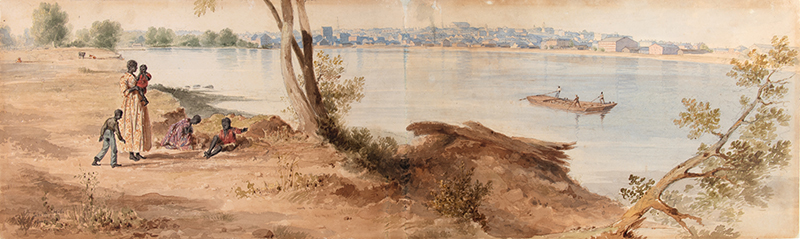
John William Hill, “View of Richmond, Virginia,” 1847 (photo courtesy of the museum).
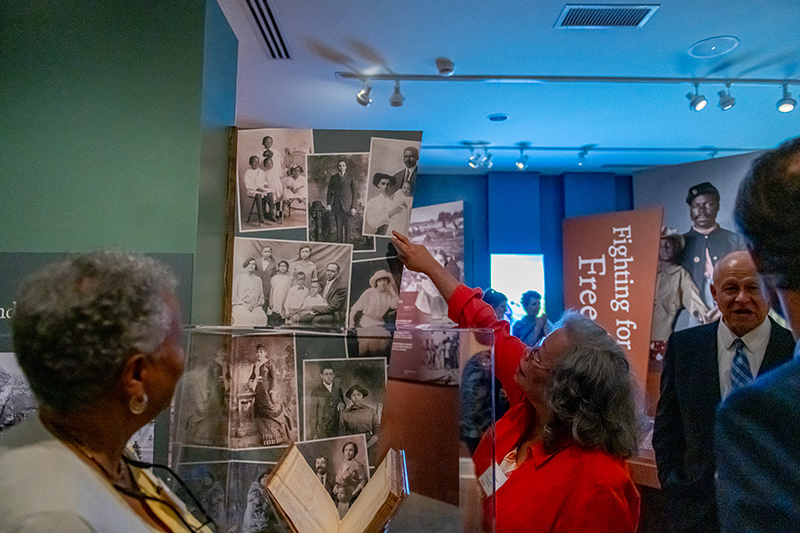
Angela Hughes Davison points to photographs of her ancestors connected with the Hezekiah Gaskins’ object on view at the new exhibition (photo courtesy of the museum).
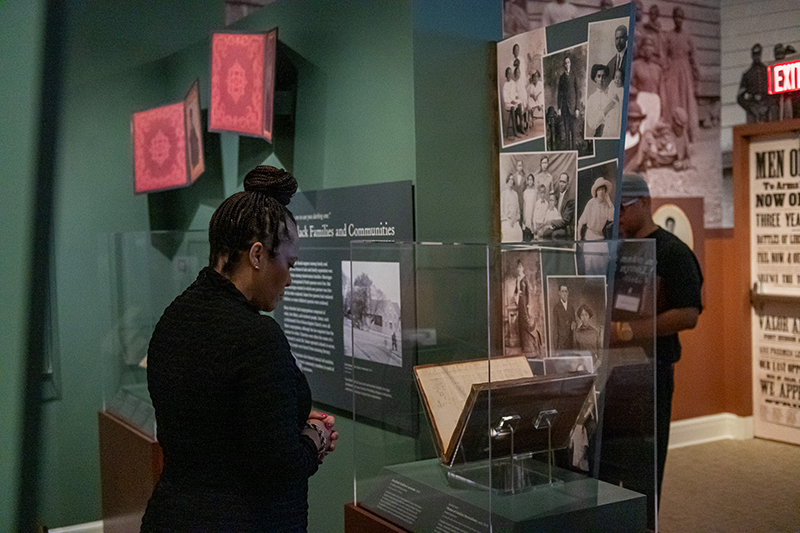
A visitor explores an exhibit at the opening of “Un/Bound: Free Black Virginians, 1619-1865” at the Virginia Museum of History & Culture (photo courtesy of the museum).
Bringing together artifacts and rich stories from across the Commonwealth, “Un/Bound: Free Black Virginians, 1619-1865” at the Virginia Museum of History & Culture (VMHC) will tell the stories of free Black Virginians from the arrival of the first captive Africans in 1619 to the abolition of slavery in 1865.
“Un/Bound” is one of the first museum exhibitions to cover the subject in depth. The exhibition opened last June and will be on display alongside VMHC’s multiyear commemorative exhibitions and displays related to America’s 250th anniversary.
VMHC created “Un/Bound” in collaboration with subject matter experts and five institutions of higher education: Norfolk State University, Virginia State University, William & Mary, Longwood University and Richard Bland College. These groups brought together resources and knowledge to tell a compelling story of Virginia.
“Un/Bound” features more than 200 years of stories about people such as Emanuel Driggus, a man who purchased his freedom and built his fortune in the late 1600s prior to codified Virginia laws that defined the terms of racial slavery. Another story told in the exhibit includes that of Joseph Jenkins Roberts, a person who was born in Virginia and relocated to Africa with his family in March 1829 to pursue opportunities not available to them in Virginia. Roberts became the first president of the new nation of Liberia, a place of refuge for many Black Americans seeking to escape discrimination.
Descendants of the people featured in “Un/Bound” has helped shape the exhibition. Among the many contributors are Evelyn Madden, who loaned items associated with her family history, and Ruddy Roye, a Jamaican-born photographer whose portraits of contemporary descendants are included in the exhibition. These portraits include Karen Hughes White and Angela Davidson, sisters who head the Afro-American Historical Association of Fauquier County; Brian Palmer, a Peabody Award-winning photojournalist; and Torrey Smith, a former NFL player and descendant of one of the more than 500 people freed by Robert Carter III.
“Un/Bound offers a comprehensive treatment of the rich, complicated history of a group of people we don’t collectively know much about,” said Elizabeth Klaczynski, VMHC’s associate curator of exhibitions. “People like Benjamin Short, a free Black man who, in 1820, signed a $200 bond with his name instead of an X — a remarkable feat for someone who was born enslaved and most likely did not know how to read or write before gaining his freedom.”
Artifacts and objects – including state records and testimonials – accompany the stories told in the exhibition. For example, Matthew Ashby’s manumission petition illustrates how a free Black man of modest means convinced the Governor’s Council to permit him to emancipate his wife and children. A student list from the Bray School in Williamsburg and a set of glass marbles highlight aspects of the lives Ashby’s family members led after achieving their freedom.
The exhibition also follows more than two centuries of the history of the Madden family in Culpeper County. The family matriarch, Sarah Madden – who was born free but indentured at a young age – became a successful seamstress and laundress following the termination of her term of indenture in 1789. Her son Willis Madden was a prosperous farmer and broke barriers as the owner of Madden’s Tavern before the Civil War.
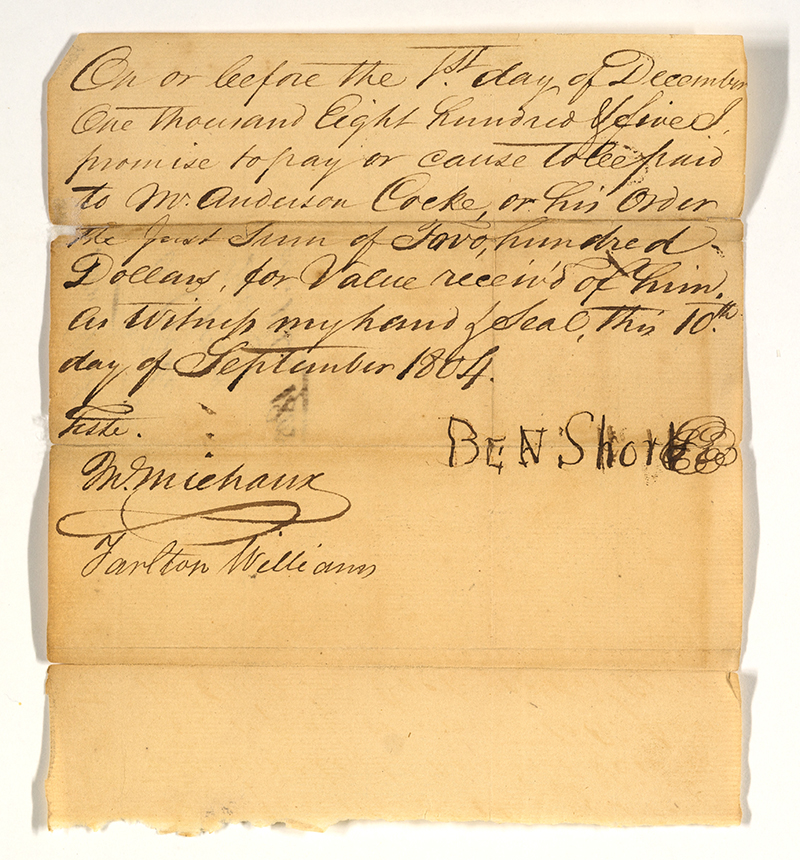
Benjamin Short’s Bond, 1820
(photo courtesy of the Library of Virginia).
Many members of the family have been prominent preachers and schoolteachers throughout the 20th century during the Jim Crow era and beyond. Their story is remembered in large part due to a family history published by T.O. Madden in 1992 and through the Maddensville Historic Site, a memorial dedicated to United States Colored Troops who served and died in the Civil War. Items such as a teaching contract and a school register are on view in the exhibition to help tell their story.
“Un/Bound” will be accompanied by a publication of the same name. It features essays by Melvin Ely, Cassandra Newby-Alexander, Stephen Rockenbach, Sabrina Watson, and Evanda Watts-Martinez. The foreword to the publication was written by three former members of the Virginia Board of Education: former Virginia Secretary of Education James Dyke Jr.; President Emeritus Tim Sullivan of William & Mary; and former interim president of Norfolk State University, Alvin Schexnider.
These educators highlight the importance of telling the stories of free Black Virginians by stating, “For decades, scholars like those featured in this publication made great strides in educating readers about enslaved Black Virginians. The centrality of slavery to Virginia’s history is obvious, but it is not the whole story… ‘Un/Bound’ – both the book and the exhibition – fills a critical gap in the public’s understanding of these courageous and captivating people.”
A traveling version of this exhibition will tour the state starting in October 2026 and continue through 2028. It is available to libraries, community centers, schools, and other public venues.
Check out the Latest Issue!
Lake Anna Connections is the premier magazine and business directory serving the entire Lake Anna area.